
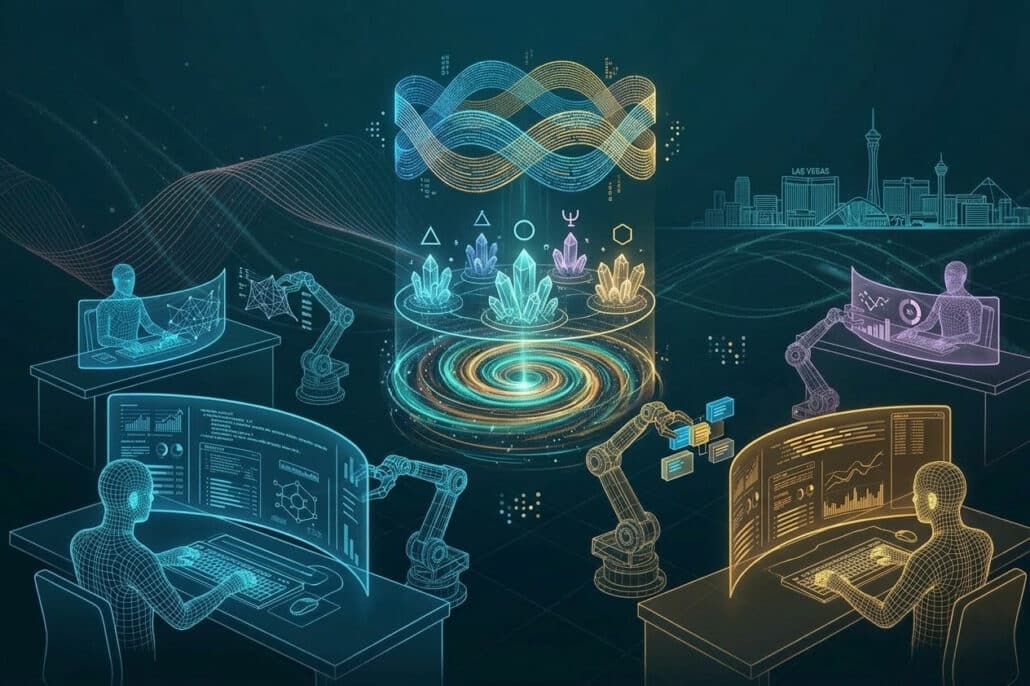
The biggest healthcare IT conference of the year just wrapped. Here’s what actually matters, and what it means for the people running your EHR, and the growing demand for specialized EHR staffing to support it.
Last week, roughly 24,000 healthcare IT professionals descended on Las Vegas for HIMSS 2026. If you followed the conference from afar, reading the press releases and scanning the vendor announcements, you’d think the industry had collectively decided to hand the keys to the robots.
Epic unveiled something called “Agent Factory.” Microsoft rebranded Dragon Copilot as an entire clinical AI platform. Amazon launched a purpose-built healthcare AI product. Google and CVS announced an agentic AI subsidiary. And the head of CMS floated the idea of putting AI agents in the hands of every single Medicare beneficiary within a year.
That’s a lot of noise. But underneath the branding exercises and the keynote stagecraft, there’s a real story here, and it’s not the one the vendors want you to focus on.
The Shift Nobody’s Ready to Staff: Why EHR Staffing Is Falling Behind
Here’s what actually happened at HIMSS 2026: the industry collectively moved from talking about AI to deploying it in production. And the gap between those two things is enormous.
Last year’s HIMSS was about generative AI experimentation: pilot programs, proof-of-concept demos, cautious optimism. This year, the dominant theme was agentic AI: systems that don’t wait for a prompt but independently execute workflows, make decisions within defined guardrails, and take actions without a human pressing “go.” As HIT Consultant put it in their pre-conference recap, if previous HIMSS years were defined by the promise of generative AI, HIMSS 2026 was about the execution of autonomous operations.
That’s a meaningful distinction. We’ve gone from “AI helps you write a note faster” to “AI handles the prior authorization, updates the chart, routes the referral, and follows up with the patient.” The technology is real. NVIDIA’s 2026 healthcare survey found that 70% of healthcare organizations are now actively using AI, up from 63% two years ago, and 47% are already using or evaluating AI agents specifically.
But here’s the number that should concern every CIO reading this: 33% of large healthcare organizations say their top challenge is a lack of AI expertise. Not budget. Not board buy-in. Not regulatory uncertainty. They can’t find the people.
You Can’t Hire Your Way Out (But You Still Need to Hire)
eClinicalWorks CEO Girish Navani summed it up bluntly at HIMSS: “You can’t hire your way out of a staffing shortage.” He was explaining why his company is building AI tools that let smaller practices do more with fewer people. And he’s right. At a macro level, the math doesn’t work. There aren’t enough nurses, there aren’t enough coders, there aren’t enough clinical informaticists.
But here’s the irony that the AI-will-fix-everything narrative glosses over: deploying agentic AI at enterprise scale requires specialized people that most health systems don’t have on staff. Different people than the ones you’re short on, yes. But people nonetheless.
Consider what Epic’s Agent Factory actually requires. It is a no-code builder that lets health systems create custom AI agents across their workflows. Sounds simple. But someone has to define the guardrails. Someone has to determine which decisions the agent can make autonomously and which require human review. Someone has to validate that an AI agent handling medication reconciliation isn’t introducing errors that a human would catch. Someone has to monitor these agents in production and retrain them when they drift.
These aren’t traditional EHR analyst roles. They’re not project managers. They’re a new hybrid: people who understand clinical workflows deeply enough to define where AI can safely operate, and who understand the technology well enough to configure and govern it. Call them AI governance specialists, clinical AI strategists, agentic orchestrators. The titles are still being invented because the roles are still being invented.
What’s Actually Being Deployed (and What It Takes)
The specific announcements at HIMSS weren’t vaporware. They’re shipping products that health systems will need to implement, integrate, and manage.
Epic now reports that over 85% of its customer base is using Epic AI tools. Agent Factory will let those customers build and deploy custom AI agents, but each agent needs configuration, testing, clinical validation, and ongoing governance. Epic also announced its own foundation models (branded “Curiosity”), trained on clinical data. That’s significant because it means health systems will be choosing between Epic’s AI, Microsoft’s AI, Google’s AI, and Amazon’s AI, and that architectural decision has five-to-ten year implications.
Microsoft expanded Dragon Copilot from an ambient documentation tool into a full clinical AI platform with an app marketplace. It’s now being used by more than 100,000 clinicians daily across nine countries. At HIMSS, Microsoft also announced a 60% discount for eligible rural hospitals, a smart move targeting an underserved market where staffing gaps are already most acute. They also partnered with Wolters Kluwer to embed UpToDate’s medical knowledge base directly into Copilot, adding clinical decision support on top of documentation.
Amazon launched Amazon Health Connect, its first purpose-built healthcare agentic AI solution. UC San Diego Health, one of the early adopters, reported a 30% reduction in call abandonment after deployment. Amazon also expanded its consumer-facing Health AI assistant to all U.S. consumers, connecting it to nationwide Health Information Exchanges.
Google Cloud went after the payer market, partnering with CVS Health to create Health100, an agentic AI consumer subsidiary backed by CVS’s $20 billion technology commitment. Google also partnered with Highmark Health, where an AI assistant called “Sidekick” handled over 6 million prompts in 2025 and reportedly generated $27.9 million in value.
Every one of these deployments requires integration specialists, EHR analysts who understand the underlying platform, project managers who can navigate the clinical governance process, and increasingly, people with data governance and AI ethics experience.
The Roles That Didn’t Exist Two Years Ago
We’re a staffing company, so we’ll be direct about what we’re seeing on the ground. Not what the conference keynotes suggest, but what health systems and AI companies are actually calling us about.
The shift started quietly about 18 months ago. We started getting job orders from companies like AKASA, an AI-powered revenue cycle automation firm, looking for HL7 analysts and Epic Clarity specialists. Not AI scientists. Traditional EHR integration people who understood the plumbing well enough to connect AI tools to production systems. Then came a request from skit.ai for an HL7 SME with Epic experience. Then an Epic Integration Consultant for DecisionQ, a predictive analytics company. A Cerner CCL AI Integration Analyst for Cleo. A NextGen Reporting Consultant for Apex Medical AI.
The pattern is unmistakable. AI companies need people who know EHR systems inside and out. And health systems deploying AI need those same people, plus new skills on top.
More recently, we’ve been fielding requests for Data Governance Analysts, Cybersecurity Data Governance Specialists, and a CISO, all of which connect directly to the AI governance challenge. When you’re deploying agentic AI that accesses patient data, makes clinical or operational decisions, and takes autonomous action, your governance, security, and compliance infrastructure has to evolve alongside it.
The roles we expect to grow fastest in 2026 and 2027 include AI integration specialists (people who bridge the gap between AI platforms and EHR infrastructure), clinical AI governance analysts, data governance and ethics specialists focused on AI-generated outputs, EHR-AI configuration analysts (especially in Epic, where Agent Factory will create a new job category), and clinical workflow architects who can redesign processes around human-AI collaboration.
The Skeptic’s Take (And Why It Still Matters)
We’d be doing you a disservice if we didn’t acknowledge some healthy skepticism here. STAT News captured the counterpoint well with its HIMSS coverage headlined around a simple question: the AI agents are here, but what about the validation?
It’s the right question. When Epic’s AI recommends a medication change, who validated the model? When Amazon’s AI triages a patient concern, what’s the liability framework? When an agentic AI autonomously processes a prior authorization, who’s accountable if it gets it wrong?
These aren’t hypothetical concerns. ARPA-H just launched the ADVOCATE program, a 39-month initiative pursuing what would be the first FDA-authorized agentic AI system, focused on cardiovascular care. The fact that a federal research agency is building this from scratch, with a multi-year regulatory runway, tells you something about how far we are from having robust governance frameworks for autonomous clinical AI.
In the meantime, health systems are deploying these tools in production. The gap between the technology’s capability and the industry’s readiness to govern it is where the real work, and the real staffing need, lives.
What This Means If You’re Making Decisions Right Now
If you’re a CIO or VP of IT at a health system, the HIMSS 2026 takeaway isn’t “rush to deploy AI agents.” It’s more nuanced than that.
First, the platform decision matters. Epic, Microsoft, Amazon, and Google are all building competing AI ecosystems. Your choice of AI platform will likely lock you in for years, similar to your EHR platform decision. Evaluate carefully.
Second, start building AI governance capabilities now, even if your AI deployment is still small. The organizations that build the governance muscle early will be able to adopt new tools faster and more safely than those scrambling to retrofit oversight after something goes wrong.
Third, recognize that your existing IT team is foundational but not sufficient, especially as EHR staffing needs evolve. The people who built and maintain your EHR environment have institutional knowledge that no AI specialist can replicate. But they’ll need augmentation, whether through training, new hires, or contract specialists, to take on the governance, integration, and optimization work that AI deployment demands.
The vendors will keep announcing exciting things. That’s their job. Your job is to staff for the reality behind the announcements.
Healthcare AI Transition Experts at HealthTECH Resources
HealthTECH Resources has been placing healthcare IT specialists for 28 years, from Epic and Oracle Cerner implementations to emerging roles in AI integration, data governance, and clinical informatics. If you’re navigating the AI transition and need experienced people who understand both the technology and the clinical context, we should explore solutions tailored to your unique needs. Contact us today to get started.

PRESIDENT/CEO AT HEALTHTECH RESOURCES
Larry has specialized in building strategic healthcare relationships for over 25 years, helping the nation’s top payors and providers solve some of their most pressing business challenges through an intelligent mix of staffing services, training, and consulting.