
RCM Configuration for Netsmart myAvatar: 5 Strategies for Behavioral Health Leaders
By Garrett Sprague, Netsmart Practice Lead
For psychiatric hospitals and behavioral health organizations, Netsmart myAvatar is the gold standard for clinical documentation. It handles the complexity of longitudinal care better than almost any other platform.
But for many CFOs and IT Directors, it remains a source of frustration when it comes to the bottom line.
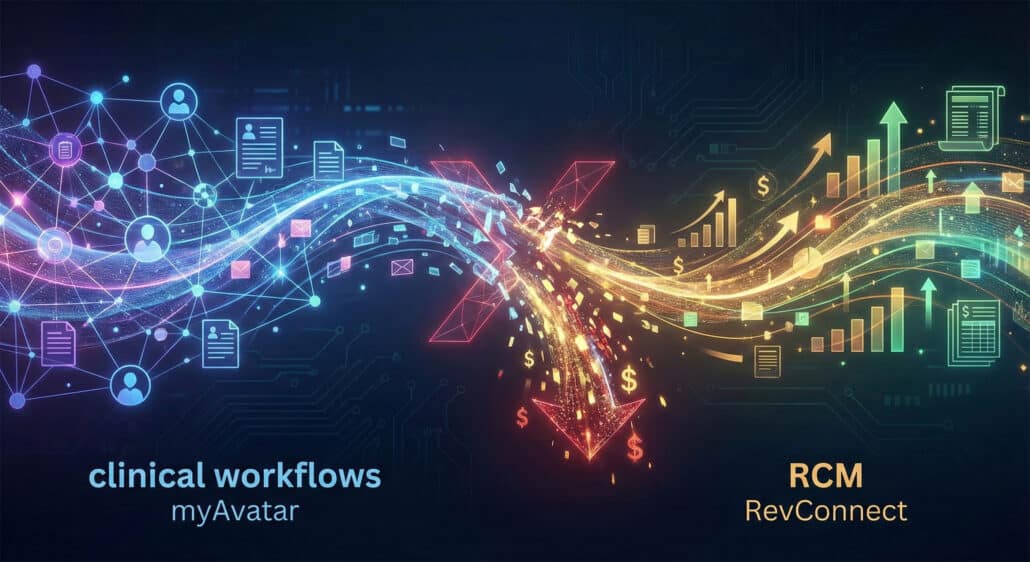
We frequently see a “Great Clinical / Poor Financial” dynamic in these environments. The clinicians have their forms, and the billing team has their clearinghouse (RevConnect), but the bridge between them is broken. Our dedicated Netsmart consulting team has helped organizations close these system gaps and rebuild critical RCM foundations.
If you are seeing high denial rates, manual workaround processes, or “shadow billing” errors, the issue likely isn’t your staff, it’s your configuration.
Here are the 5 technical gaps we see most often in myAvatar environments, and how to close them to stop revenue leakage.
1. The “ScriptLink” Gap: Validation at the Point of Care
Modern myAvatar NX forms are powerful, but they require advanced logic to ensure data quality. Too many organizations rely on “flat” forms that allow clinicians to skip critical billing fields because they aren’t clinically relevant to them.
The Problem: A clinician closes a note for “Crisis Intervention.” They document the clinical narrative beautifully but fail to enter the specific start/stop time required by the payer. The system allows them to sign the note.
The Leak: The claim hits the billing office three days later. The coder sees the missing time, queries the clinician (who has now moved on to 20 other patients), and the claim sits in “held” status for weeks.
The Fix: You cannot rely on training alone. You must deploy ScriptLink developers to build “conditional logic” directly into the NX forms. If a clinician selects a specific service code, ScriptLink should dynamically trigger a “hard stop” that forces the entry of the required billing elements (Time, Location, CPT modifiers) before the note can be signed.
2. The CCBHC “Shadow Billing” Trap
For organizations transitioning to the Certified Community Behavioral Health Clinic (CCBHC) model, the billing requirements are exponentially more complex. You aren’t just billing for the service; you are tracking the “shadow claim” (T1040/H-code) to trigger the Prospective Payment System (PPS) rate.
The Problem: Generic RCM configurations often view the service and the shadow claim as separate events. If a biller forgets to manually attach the shadow code, or if the system doesn’t auto-generate it based on the encounter type, the claim is incomplete.
The Leak: You might get paid the base rate, but you miss the PPS wrap-around payment—or worse, you trigger an audit because your encounter data doesn’t match your state reporting.
The Fix: Automation is mandatory here. Your RCM configuration must be set up to bundle these services automatically. When the primary service is coded, the system logic should immediately append the correct shadow code and modifier without human intervention.
3. RevConnect: Moving Beyond “Send and Receive”
Many organizations use RevConnect simply as a mailbox to send claims to payers. They are missing 50% of the platform’s value, particularly regarding 835 ERA (Electronic Remittance Advice) automation.
The Problem: Your team sends claims digitally but manually posts the remittances because the 835 files aren’t parsing correctly back into myAvatar.
The Leak: Manual posting is slow and error-prone. It delays your ability to work denials because you don’t know a claim was rejected until days after the file comes in.
The Fix: We help organizations configure Claim Scrubber Rules upstream to catch errors (like incompatible diagnosis codes) before the claim leaves. More importantly, we resolve the 835 file parsing errors so that payments and denials auto-post to the patient ledger. This allows your team to work “exceptions” rather than doing data entry.
4. The “Click Fatigue” Factor (UX Design)
In psychiatric hospitals, speed is safety. If an intake nurse has to click 40 times to admit a patient because they are navigating through five different “legacy” widgets, that is a clinical risk. It is also a billing risk, as frustrated staff are more likely to take shortcuts.
The Fix: Move from legacy views to myAvatar NX simplified workflows. We specialize in redesigning intake and assessment forms to strip out unused fields and consolidate views. Reducing “time-to-documentation” by even 20% significantly improves code capture and staff retention.
5. The Missing Feedback Loop (KPI Dashboards)
Often, the Billing Director knows exactly why claims are being denied (e.g., “Dr. Smith always forgets the modifier on partial hospitalization”), but that data is trapped in the billing office.
The Fix: You need KPI Dashboards (using Qlik or NX Analytics) that visualize RCM health for clinical leadership.
-
“Denials by Clinician”
-
“Lag Time: Date of Service vs. Date Signed”
-
“Top 10 Rejection Reasons”
When clinical directors can see the financial impact of documentation habits, behavior changes.
The Bottom Line
Your myAvatar system should be an asset, not an administrative burden. But it requires the right architecture to align your clinical reality with your financial goals.
Whether you need a ScriptLink developer to automate your forms, an RCM Specialist to fix your 835 setups, or a Solution Architect to redesign your workflows, HealthTECH provides the specific expertise to stabilize your environment.
Does your myAvatar environment need an optimization audit? Reach out to me directly to discuss how we can streamline your revenue cycle.

Garrett Sprague
Sr. Director, EHR & IT Advisory Services | Netsmart Division
(480) 618-0423 x423 | gsprague@healthtech-resources.com

PRESIDENT/CEO AT HEALTHTECH RESOURCES
Larry has specialized in building strategic healthcare relationships for over 25 years, helping the nation’s top payors and providers solve some of their most pressing business challenges through an intelligent mix of staffing services, training, and consulting.